

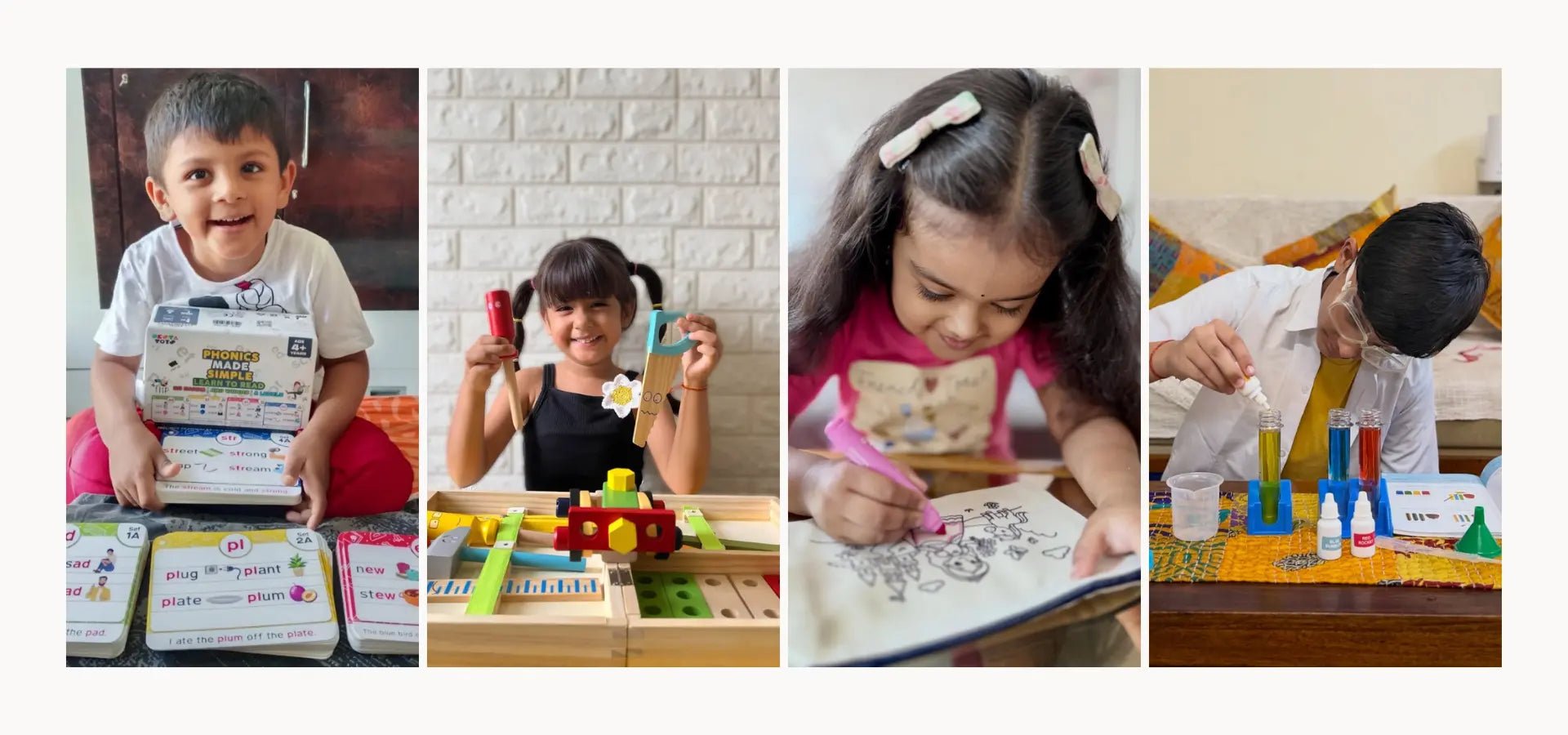
A NESTA Research report on what the evidence actually shows about free play, guided play, toys, and how young children learn
What if play isn't the opposite of learning?
For most of childhood, that's actually closer to the truth. Watch a toddler stack blocks for the tenth time, or a four-year-old run the same pretend shop she ran yesterday, and it doesn't look like a break from development. It looks like development happening in real time, minus the worksheet.
"Play is good for children" gets said so often that nobody stops to ask what it actually means. Is guided play better than free play, or is that mostly something on the toy box? Does something need an "educational" sticker to be worth buying? This report goes through what the research actually shows, and it's messier, and more interesting, than the slogans.
What Does "Play" Mean?
Not all play is the same activity wearing different costumes. Researchers, and India's own early-childhood policy, generally describe a continuum.
- Free play: the child has substantial control over what to play, how to play it, and for how long. No adult-set goal.
- Guided play: the child still leads and makes real choices, but an adult or the environment introduces a gentle learning intention, say, a set of shape blocks arranged to invite sorting, or a parent asking a question that nudges exploration in a direction.
- Structured play: an adult or the activity itself provides more direction, while keeping the experience playful rather than instructional.
- Play-based learning: the broader umbrella term for using playful activity, from anywhere along this spectrum, on purpose, to support a learning goal.
India's National Curriculum Framework for the Foundational Stage (NCF-FS), 2022 uses this exact continuum, and doesn't treat play as something children earn after finishing the "real" work. Play sits at the centre of the framework. That's more than a nice line in a policy document; it actually changes how a foundational-stage classroom in India is supposed to be set up.
How Play Can Support Development
Language and communication: conversation, storytelling, vocabulary building, back-and-forth interaction.
Social-emotional development: negotiation, cooperation, emotional expression, relationship-building.
Self-regulation: planning, shifting attention, managing impulses, adapting to changing situations, where evidence supports these links.
Physical development: movement, coordination, and motor skill opportunities.
The American Academy of Pediatrics' clinical report, "The Power of Play" (reaffirmed in January 2025) frames developmentally appropriate play as supporting exactly these domains, and specifically highlights the caregiver-child relationship built through play as significant in its own right, not just a delivery mechanism for other skills.
Worth being precise here: not every play activity produces every one of these benefits equally. A quiet solo puzzle and a loud pretend-play game with three other kids are both good for a child, just not in the same way. What a child actually gets out of playing depends on the activity, the materials at hand, the child themselves, and whether an adult is nearby, and doing what.
Free Play, Guided Play, or Structured Play, Which Is Best?
This is probably the question with the most solid evidence behind it, and, ironically, the easiest one to flatten into a marketing line.
Skene and colleagues ran the most useful study on this in 2022, a systematic review published in Child Development. They looked at 39 studies on guided play going back to 1977, then pooled 17 of the strongest into a meta-analysis covering close to 3,900 children between ages 1 and 8.
The findings are genuinely interesting, and more specific than "guided play wins." Guided play showed a meaningfully larger positive effect than direct instruction on early maths skills, shape knowledge, and task-switching, and a larger effect than free play specifically on spatial vocabulary. For a number of other outcomes measured across the included studies, no significant difference was found between approaches.
So the honest answer to "which is best" is that different forms of play appear to serve different purposes. Guided play seems to have a real edge for certain targeted learning goals. Free play remains valuable for the things it's always been valuable for, autonomy, self-directed exploration, and the kind of open-ended engagement that doesn't fit neatly into a measurable outcome. Neither replaces the other.
Does the Type of Toy Matter?
Rather than ranking toy brands or categories, it's more useful to ask what characteristics actually create opportunities for meaningful play. Research and clinical guidance point toward materials that let a child:
- Build, stack, or construct
- Manipulate, sort, or categorise
- Pretend and take on roles
- Create something that didn't exist before
- Experiment and see a different result each time
- Repeat the same activity without it losing value
- Be used in more than one way
The AAP's clinical report on selecting toys for young children in the digital era makes a point worth sitting with: a toy's price or technological sophistication doesn't reliably predict how developmentally rich the interaction around it will be. Simple materials, blocks, shape sorters, open-ended pretend-play props, can offer rich opportunities precisely because they don't dictate a single "correct" way to play.
One controlled study gives a specific, useful data point here. Sosa (2016) observed 26 parent-infant pairs (infants aged 10-16 months) during structured play sessions using electronic toys, traditional toys, and books. Parent-infant communication, measured through adult word count, child vocalisations, and conversational turns, was consistently richer during play with traditional toys and books than during play with electronic toys.
It's worth being precise about what this study does and doesn't show. It's a small, single controlled study, not a large randomized trial, and it doesn't prove that electronic toys cause developmental harm. What it does show, credibly, is that in this specific comparison, electronic toys were associated with less rich verbal interaction between parent and infant than traditional toys or books were, likely because electronic toys often do more of the "talking" themselves, leaving less space for the back-and-forth exchange that drives early language growth.
What About "Educational" Toys?
Here's a genuinely important myth to address directly: a toy being marketed as educational doesn't automatically mean it produces a developmental benefit. That label describes marketing, not evidence.
A more useful question than "is this educational" is: what does the child actually get to do with it?
- Does the child have meaningful choices in how to use it?
- Can the child experiment and get different results?
- Can it be used in more than one way?
- Does it invite communication with a caregiver or another child?
- Does it hold up to repetition without losing its value?
- Is the challenge level appropriate for the child's current stage?
- Can an adult participate meaningfully alongside the child?
A toy that scores well on these questions is likely to support development regardless of whether the packaging says "educational." A toy that scores poorly on them isn't rescued by the label.
The Role of Parents and Caregivers
An adult doesn't need to direct every minute of a child's play for that play to matter. If anything, stepping in too often can crowd out the exact kind of exploration that makes play worthwhile in the first place. What the evidence points toward instead is a lighter touch:
- Following the child's current interest rather than redirecting it
- Asking open-ended questions instead of giving instructions
- Naming what the child is doing ("you're stacking the blue ones together")
- Extending a conversation the child has already started
- Modelling an idea occasionally, without taking over
- Joining in when it genuinely adds something
- Allowing stretches of independent exploration without commentary
- Resisting the urge to turn every play session into a lesson
What seems to matter most isn't any specific toy or activity. It's the interaction itself, a child being noticed, responded to, and joined in on now and then.
What Does Research Actually Say About Pretend Play?
Pretend play has enormous intuitive appeal, a child running a pretend kitchen or acting out a story is clearly doing something rich and imaginative. But it's worth being honest about where the science actually stands, rather than repeating the common claim that pretend play has been conclusively proven to build executive function or specific cognitive skills.
A widely cited review by Lillard and colleagues, published in Psychological Bulletin, examined the evidence behind claims that pretend play causally drives improvements in areas like creativity, language, and self-regulation. The review's conclusion was more cautious than popular parenting content usually suggests, the existing evidence for many of these specific causal claims was found to be weak, correlational, or inconsistent across studies, rather than clearly established.
This doesn't mean pretend play isn't valuable. It's still a rich, widely recognised, developmentally significant form of children's activity, one that naturally involves language, social negotiation, and symbolic thinking. It just means the stronger, more specific causal claims ("pretend play builds executive function") outpace what controlled research has actually demonstrated so far.
What About Open-Ended and Loose-Parts Play?
Materials without one predetermined "correct" way to use them, blocks, fabric scraps, natural objects, open containers, give children room to combine, construct, test, modify, and invent their own rules. The logic makes sense on its own terms: a material that can turn into ten different things asks more of a child's thinking than one with a single obvious use.
Research on loose-parts and open-ended play generally backs this up, these materials do seem to create real chances for exploration and problem-solving. But study quality varies a fair bit across this research, and claiming open-ended materials automatically produce better cognitive outcomes than structured alternatives would be reaching further than the evidence goes. Plausible and reasonably well supported is different from proven.
What India's Foundational-Stage Framework Says
India's NCF-FS 2022, part of the broader NEP 2020 reforms, puts play-based learning at the structural centre of the foundational years, not as a warm-up before the "real" academics start. It uses the same free play, guided play, structured play continuum this report has been using, and it puts the responsibility on the educator to work out which type of play actually fits a given moment, rather than defaulting to one approach every time.
For Indian parents, this matters beyond the policy document itself, it signals that a play-centred approach to a young child's early years isn't a alternative or "soft" choice. It's the approach India's own foundational education policy is built around.
What the Research Does Not Prove
Evidence: Not established as a universal causal claim. What matters is what a child actually gets to do with a material, not its marketing label.
Evidence: Research doesn't support a universal winner. Different forms of play appear to serve different, sometimes non-overlapping purposes.
Evidence: Guided play shows an advantage for specific, targeted outcomes like early maths and shape knowledge, not a general superiority over free play.
Evidence: AAP guidance explicitly does not support this assumption. Simple materials often create richer opportunities than complex ones.
Evidence: Too broad a claim. One controlled study found less rich communication during electronic-toy play compared to traditional toys, which is meaningfully different from proving every electronic toy is harmful.
Evidence: A major review found this evidence weaker and more inconsistent than commonly assumed.
What Parents Can Actually Do
If balancing screen-based and hands-on activity is a concern in your household, our earlier report on screen time in early childhood looks at that specific question in more depth, this report's focus is play itself, not screens.
Conclusion
Good play isn't about keeping a child occupied, or maximising the number of activities that can be labelled "learning." Across the evidence in this report, the throughline is simpler than that: play matters because it gives children real opportunities to explore, choose, experiment, communicate, move, imagine, and interact with the people around them.
The best play environment for a child isn't necessarily the most expensive, the most structured, or the most technologically advanced. It's the one that gives a child genuine opportunities to engage, at whatever point along the free play to structured play continuum happens to fit that moment.
About the Author
Neha Makdey is the Co-Founder & CEO of NESTA TOYS - India’s homegrown educational toy brand loved by over 3 lakh curious kids. NESTA Toys designs research-backed, hands-on learning toys for children aged 1–10, available on Amazon, Blinkit, Swiggy Instamart, and nestatoys.in. Follow NESTA TOYS on WhatsApp and Pinterest for free parenting resources and activity ideas.
FAQs
What is play-based learning?
It's exactly what it sounds like: children learning through play rather than sitting through direct instruction. But it's not one thing, it runs on a spectrum. On one end, free play, the child's fully in charge. On the other, structured play, an adult sets more of the direction. Guided play sits in between, the child still leads, but a parent or the materials nudge things gently toward a goal. India's NCF-FS 2022 treats this whole spectrum as core to early education, not something separate from "real" learning.
Is guided play better than free play?
Depends what you're measuring. A 2022 meta-analysis pooling data on nearly 3,900 children found guided play pulled ahead for specific things, early number sense, recognising shapes, switching between tasks. For a lot of other outcomes, though, the two showed no real difference. So it's not that one wins outright, guided play seems to earn its keep on certain skills, and free play keeps doing what it's always done: giving a child room to just explore on their own terms.
Do educational toys actually help children learn?
The "educational" label on a box tells you about the marketing, not necessarily the outcome. What actually matters is simpler: can the child make real choices with it, use it more than one way, come back to it a dozen times without it getting boring? A basic set of blocks that checks those boxes will often do more for a child than a flashier toy that doesn't, regardless of what the packaging promises.
Why is pretend play important for child development?
There's no disputing that pretend play is rich, a child running a made-up scenario is using language, imagination, and social skills all at once. Where the science gets more careful is on the bigger claims you'll see repeated online, that it directly builds executive function or measurably boosts cognition. A well-known review looked hard at this and found the evidence thinner and more mixed than those claims suggest. Valuable, yes. Proven to cause specific cognitive gains, not quite there yet.
Are expensive toys better for child development?
Not according to the American Academy of Pediatrics, who address this directly in their toy guidance. Price tag doesn't predict developmental value. A cheap shape sorter or a pile of building blocks often creates more genuine learning opportunity than an expensive, feature-packed toy, mainly because simpler materials don't box a child into one "right" way of playing with them.
What's the difference between free play, guided play, and structured play?
Free play: the child decides everything, what to play, how, for how long. Structured play: an adult sets most of the direction, though it still feels playful rather than like a lesson. Guided play lands in the middle, the child's still driving, but a parent's question or the way materials are set up quietly points toward something. This is the same three-part framework India's NCF-FS 2022 builds its early-education approach around.
What is loose-parts play, and does it actually help children learn?
It's play with materials that don't come with instructions, blocks, fabric scraps, sticks, anything a child can turn into whatever they want. The research on this is generally positive, it does seem to open up real exploration and flexible thinking. That said, the studies behind it vary quite a bit in quality, so "well-supported" is a more honest description than "proven." It's a good bet, not a guaranteed outcome.
Should parents get involved in their child's play, or let them play alone?
Both, and it's less about picking one than knowing when each fits. The evidence leans toward a lighter touch when you do join in, following what the child's already interested in, asking a question instead of giving an instruction, sitting in rather than taking over. But uninterrupted solo play matters just as much, it's not a consolation prize for when a parent's too busy to join. Neither one replaces the other.
Sources
- Skene K, O'Farrelly CM, Byrne EM, Kirby N, Stevens EC, Ramchandani PG. Can guidance during play enhance children's learning and development in educational contexts? A systematic review and meta-analysis. Child Dev. 2022;93(4):1162-1180. doi.org/10.1111/cdev.13730
- Sosa AV. Association of the type of toy used during play with the quantity and quality of parent-infant communication. JAMA Pediatr. 2016;170(2):132-137. doi.org/10.1001/jamapediatrics.2015.3753
- Yogman M, Garner A, Hutchinson J, et al; AAP Committee on Psychosocial Aspects of Child and Family Health. The Power of Play: A Pediatric Role in Enhancing Development in Young Children. Pediatrics. 2018;142(3):e20182058. publications.aap.org
- American Academy of Pediatrics. Selecting Appropriate Toys for Young Children in the Digital Era. Pediatrics. 2019;143(1):e20183348. publications.aap.org
- Lillard AS, Lerner MD, Hopkins EJ, Dore RA, Smith ED, Palmquist CM. The impact of pretend play on children's development: a review of the evidence. Psychol Bull. 2013;139(1):1-34. pubmed.ncbi.nlm.nih.gov/22905949
- Ministry of Education, Government of India. National Curriculum Framework for Foundational Stage 2022. education.gov.in


