

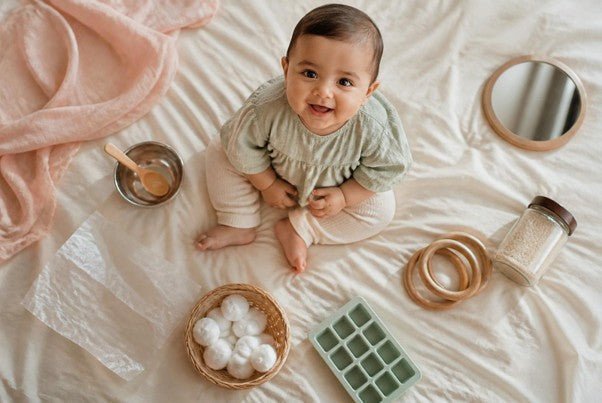
In the first year, your baby’s brain is doing the heaviest lifting it will ever do - building more than a million neural connections every second. And the fuel for all that wiring isn’t fancy gadgets or screens. It’s sensory play - the simple act of touching, hearing, watching, mouthing and moving.
The best part? You already own everything you need. A stainless steel katori, a muslin dupatta, a jar of rice, a wooden spoon - these humble household items are some of the most powerful learning tools your baby will ever hold.
Here are 12 safe, screen-free sensory play ideas you can set up in under 5 minutes, sorted by age. We have also mapped each stage to a baby development milestone tracker so you know what to look for alongside the play.
Why sensory play matters in the first year
Sensory play helps babies:
- Build neural pathways for language, motor skills and problem-solving
- Develop hand-eye coordination through reaching, grasping and releasing
- Regulate emotions - deep sensory input soothes a fussy baby
- Discover cause and effect (“I shake this → it makes sound”)
- Strengthen core, neck and fine motor muscles during tummy time and sitting play
A landmark Harvard Center on the Developing Child paper puts it simply: “Serve and return” interactions with everyday objects are the single strongest predictor of early cognitive development. You don’t need a subscription box. You need 10 minutes and a laundry basket.
0–3 months: High contrast, gentle sound, familiar voice
Newborns see best in black, white and red at about 8–12 inches away. Keep it slow and simple.
1. DIY black & white flashcards
Cut a cereal box into rectangles, draw bold black patterns (stripes, circles, spirals) with a marker. Hold each card 20 cm from baby’s face for 30 seconds. Watch them lock eyes and track.
Builds: visual focus, neck strength.
2. Steel katori shake
Put 3 dry rajma beans inside a small steel katori, tape it shut with masking tape. Shake gently near the left ear, then the right. Baby will turn toward the sound by week 8.
Builds: auditory localisation.
3. Dupatta peekaboo
Drape a soft cotton dupatta over your face, pull it away with a soft “boo!” Repeat. This is the very first lesson in object permanence.
Builds: emotional bonding, anticipation.
Want to see what’s expected at this stage? Check the 0–3 month baby development milestones guide from TheMamaCircle.
3–6 months: Reaching, grasping, mouthing
Baby is now batting at things and everything ends up in the mouth. Choose items large enough not to be a choking hazard (bigger than a 35 mm film canister lid).
4. Wooden spoon + steel plate drum
Sit baby in your lap. Place an upside-down steel plate on the floor. Hand them a wooden spoon. The clang is loud, glorious, and teaches cause-and-effect faster than any electronic toy.
Builds: cause-effect, grip strength.
5. Silicone ice tray treasure basket
Fill a silicone ice tray (the soft, non-choking kind) with one item per slot - a wooden bangle, a satin ribbon, a crinkly piece of butter paper, a soft ball of cotton. Let baby explore textures one at a time.
Builds: fine motor, tactile discrimination.
6. Mirror tummy time
Prop an unbreakable mirror against a cushion during tummy time. Seeing their own face motivates babies to lift their head longer.
Builds: neck strength, self-recognition.
Around 4 months, babies start holding their head steady, rolling tummy-to-back and reaching for toys. Read the full baby development milestones at 4 months to track what comes next.
6–9 months: Sitting up, banging, transferring
This is the golden age of container play. Baby wants to put things IN and take them OUT - over and over.
7. Katori-in-katori nesting
Give baby 3 stainless steel katoris of different sizes. Show them how to stack and un-stack. Expect chaos. Expect learning.
Builds: spatial reasoning, hand transfer.
8. Dupatta pull-through
Take an empty tissue box, thread three colourful dupattas or old cotton chunnis through the opening so they’re loosely connected. Baby will pull them out endlessly.
Builds: pincer grip, cause-effect.
9. Water play in a paraat
On a hot afternoon, place a shallow steel paraat with 2 cm of lukewarm water on a towel. Add a wooden spoon and a small plastic cup. Sit right next to baby - never leave them alone with water, not even for a second.
Builds: sensory regulation, motor planning.
Looking for a week-by-week guide for this stage? TheMamaCircle’s infant development milestones chart covers motor, cognitive, social and communication skills for Indian babies from birth to 4 years.
9–12 months: Cruising, pointing, imitating
Baby is a scientist now - testing gravity, cause and effect, and your patience.
10. Rice sensory bin (with supervision)
Fill a wide steel thali with 2 inches of raw rice. Hide a wooden bangle inside. Sit with baby and let them scoop, pour, and dig. Only when baby has stopped mouthing everything - usually 10 months+. Never leave unattended.
Builds: fine motor, discovery.
Wondering what milestones a 9 month old should be doing? Most can sit without support, crawl, pull to stand, and pick up small objects with a pincer grasp.
11. Muffin tin surprise
Turn a 6-cup muffin tin upside down. Hide a wooden ball or small silicone toy under each cup. Baby learns to lift, remember, and repeat.
Builds: memory, object permanence.
12. Basket dump
Fill a small woven basket with 5–6 open-ended items - a wooden ring, a soft ball, a large silicone teether, a fabric scrunchie. Baby will empty it, you will refill it. This is Montessori-style “practical life” in its earliest form.
Builds: independent play, categorisation.
Safety checklist before you start
- Choking test: if it fits through a toilet paper roll, it’s too small.
- Never leave baby alone with rice, water, small objects, or ribbons longer than 20 cm.
- Wash items in warm soapy water - everything WILL go in the mouth.
- Skip: button batteries, magnets, uncooked pulses smaller than a chana, plastic bags, latex balloons.
- Follow baby’s lead. If they’re fussy, stop. Sensory play should feel like play, not a curriculum.
When to upgrade to open-ended toys
Around 8–10 months, most babies are ready for their first set of open-ended wooden toys - the kind that don’t do anything on their own so baby has to bring the imagination. That’s when nesting cups, wooden stackers, and simple push-pull toys start earning their place on the shelf.
At NESTA TOYS, we design every wooden toy around one question: what will this child’s hands and brain be doing at this age? Our wooden sensory sets for babies 6–12 months are built to sit alongside your katori and dupatta - not replace them.
Want a week-by-week guide for your baby’s first year?
If you’re wondering “what should we be doing at 4 months? at 7 months?”, our friends at TheMamaCircle have put together a free baby development milestones book for Indian babies - including play ideas, feeding cues, and red flags to watch for. It pairs beautifully with the sensory bin you just set up. You can also try their free DIY activity library for more screen-free play ideas.
The bottom line
Your baby doesn’t need a toy that lights up, sings the ABCs, or promises to raise their IQ. They need YOU, a few safe household items, and 10 unhurried minutes. That’s the whole formula. Everything else is decoration.
About TheMamaCircle:
TheMamaCircle is India’s first personalised postnatal care and recovery platform for mothers - and a free resource for tracking baby milestones, pregnancy weeks, and safe DIY play ideas. This article was contributed by the TheMamaCircle team in partnership with NESTA TOYS. Visit themamacircle.in to follow along with your baby’s first year.
About NESTA TOYS:
We make heirloom-quality wooden and open-ended toys designed for the way Indian children actually play. Every piece is safety-tested, sustainably sourced, and made to last through siblings. Shop the baby collection →


