

Early Learning

Educational Toys vs Montessori Toys: What's the Difference and Which Is Right for Your Child?
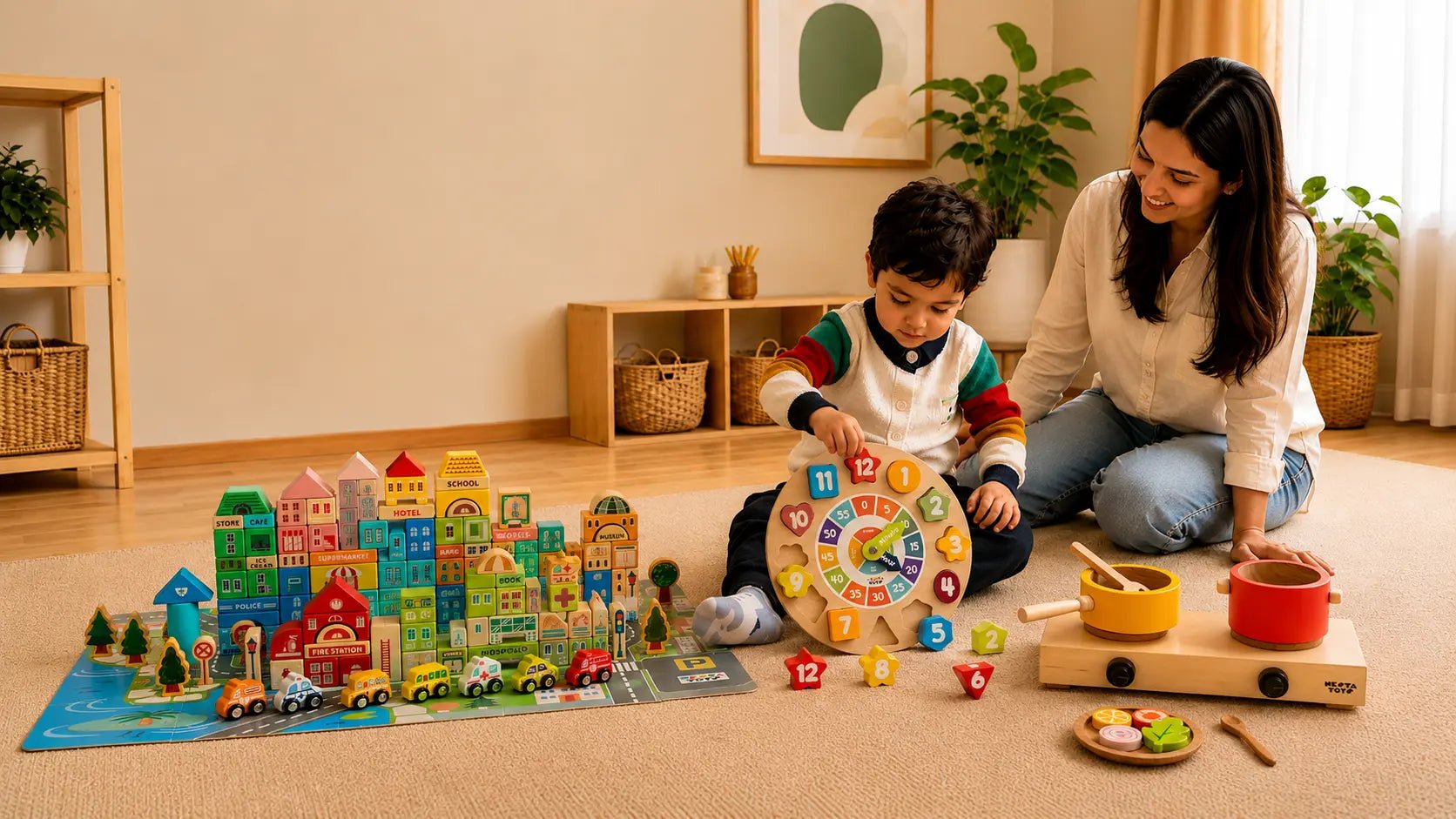
A lot of parents start out searching for educational toys, then stumble onto the term "Montessori toys" somewhere along the way and start wondering if they're the same thing, or if they need to throw out one and switch to the other. Good news: you don't need to pick a side. Both approaches genuinely support learning through play, they're just not identical. This guide walks through where they overlap, where they differ, and how to actually decide what fits your child, without treating either one as the "right" answer. If you're just getting started, what educational toys are, why they matter, and how to choose them are already covered in earlier posts in this series. What Are Educational Toys? In short: educational toys are any toys that get a child actively involved while they play, thinking, building, solving, rather than sitting back and watching something happen.It's a wide net. Building blocks, puzzles, pretend-play sets, board games, all of it can qualify, as long as the toy actually asks something of the child. There's no single design style behind the category, just the requirement that the child is doing real work, not just observing.Key takeaway: Educational toys are the big umbrella. Lots of different toys fit under it. What Are Montessori Toys? Montessori toys are a bit more specific. They're built around the principles of Montessori education, letting a child explore independently, at their own pace, with the adult stepping back rather than directing. Dr. Maria Montessori's approach is built on the idea that children learn best through hands-on, self-directed activity. So Montessori toys usually have one clear purpose, they're designed to be mastered through repetition, and a lot of them connect to real-life skills, pouring water, buttoning fabric, sorting objects by size. Wood shows up a lot in Montessori design because it's simple and natural, but wood alone doesn't make something Montessori.Here's maybe the easiest way to picture it: educational toys are the broad category, anything that helps a child learn through play. Montessori toys live inside that category, they're just built around one specific philosophy rather than a general goal. A quick example: a colorful shape sorter with lights and different functions is a general educational toy. A plain wooden box where a child drops a ball through a hole and fishes it back out themselves, no lights, one clear task, is Montessori. Same broad idea, learning through play, just a much narrower, more deliberate design behind it. Key takeaway: Every Montessori toy counts as educational. Not every educational toy is Montessori. Where the Two Actually Differ Purpose. Educational toys usually target a general skill, creativity, motor development, problem solving, whatever it is. Montessori toys are built around one specific principle, usually independence or some real-world task. Neither approach is doing "more" here, they're just aimed differently. How the child learns. Some educational toys are open-ended, some are fixed and single-purpose, it really depends on the toy. Montessori materials are almost always self-paced and child-led, with very little correction from an adult while the child works through it. How much the parent's involved. A lot of educational toys, board games especially, or pretend kitchens, actually work better with a parent joining in. Montessori materials are usually meant for a child to use on their own once you've shown them how, once, and then stepped back. What they're made of. Educational toys come in pretty much any material, wood, good-quality plastic, fabric, depending on what the toy needs to do. Montessori toys lean toward natural materials, mostly because simplicity is baked into the philosophy, not because plastic is somehow disqualifying. How they connect to real life. Educational toys might or might not tie into something practical. Montessori materials usually do on purpose, think tiny pouring jugs, dressing frames with real buttons, kid-sized food prep tools.Worth remembering through all of this: both are genuinely good options. This isn't really a "pick the winner" situation. Educational Toys vs Montessori Toys: Side by Side Feature Educational Toys Montessori Toys Purpose Support general developmental skills Support specific Montessori principles Learning style Can be open-ended or fixed-function Typically child-led and self-paced Adult involvement Often benefits from shared play Usually designed for independent use Materials Wide range, including quality plastic Often natural materials like wood Open-ended play Varies by toy Common, though purpose is usually singular per activity Real-life skills Sometimes included Frequently central to the design Creativity Often encouraged directly Emerges through independent exploration Typical examples Building blocks, puzzles, pretend-play sets Object-permanence boxes, practical life trays, sensory materials Best suited for Broad developmental play across many skills Children who thrive with independent, self-paced exploration Can You Use Both? (Short Answer: Yes, and You Probably Already Do) Most families aren't picking one system and sticking to it, they're mixing both without really thinking about it. One afternoon might have a Montessori-style pouring activity, a set of blocks, a board game, and a full pretend-play session, all before dinner.Kids don't sort their own play into categories like that. We do. In practice the two blend together pretty seamlessly in most homes, and there's no rule saying you need to commit to one philosophy.A small observation worth mentioning: plenty of kids naturally combine Montessori-style materials with imaginative play and never notice any difference between the two. The category label matters a lot more to how a shelf gets organized than to how a child actually plays.Key takeaway: If your kid's day already looks like a mix of both, that's normal, not something to fix. How to Figure Out What Fits Your Child Instead of starting with a philosophy, it usually works better to start with the kid in front of you. Personality. Some kids love mastering one focused task through repetition. Others get more out of open-ended toys they can use ten different ways. Attention span. Montessori materials tend to reward sitting with one thing for a while. Kids who bounce between activities quickly might click more with varied educational toys instead. Home setup. A calmer, less cluttered play area tends to suit Montessori-style materials well. A busier house with siblings running around often leans naturally toward broader, more flexible educational toys. Budget. Neither approach requires spending a lot. Some of the best Montessori materials are dead simple, and plenty of good educational toys are affordable too. The biggest wins usually come from matching the toy to the actual kid, not to whichever approach is trending in a parenting group that week. Kids tend to learn best when they feel free to move at their own pace, whichever category that technically falls under. Common Myths Worth Clearing Up "Montessori toys are always expensive." Not really. A lot of the best Montessori materials are intentionally basic, a simple wooden sorting tray costs a fraction of plenty of mainstream toys. "Educational toys have to light up or make noise." Some do, sure, but plenty of the most effective ones, wooden blocks being the obvious example, have zero lights or sound. "If it's wood, it's Montessori." Not automatically. Wood shows up a lot in Montessori design, but it's the philosophy behind the toy that actually makes something Montessori, not the material it's carved from. "You have to do Montessori perfectly or it doesn't count." Not true at all. Even loosely applying the core idea, stepping back and letting a kid explore on their own sometimes, still offers real benefit. "One of these is just better than the other." Both genuinely work. Which one fits better really comes down to the specific kid, not which philosophy has more buzz right now. A Quick Note on Quality Whichever direction you lean, the same basic quality checks apply, smooth finishes, safe materials, sturdy construction, they matter just as much for a Montessori sorting tray as for a set of building blocks. We went through exactly what to check for in our buying guide, worth a look since it applies to both categories equally. NESTA TOYS builds both its educational and Montessori-inspired collections around these same basics. A Quick Way to Decide Does my kid like repeating one activity, or hopping between several? Do they enjoy figuring things out alone, or do they light up more during shared play? Is our home more of a calm, focused space, or a busier, more chaotic one most days? Am I after something tied to a real-life skill, or something open to broader imaginative use? Would they benefit more right now from mastering one specific task, or from having lots of options?There's no wrong answer here. Most kids will honestly fit into both categories depending on the day, sometimes depending on the hour. Conclusion Educational toys and Montessori toys are really headed toward the same place, helping kids learn through play that actually means something. Every Montessori toy is educational by definition, it's just built around a tighter set of principles. And educational toys don't need to follow Montessori rules to genuinely help a child grow. The label matters a lot less than how thoughtfully the toy supports your child's curiosity. Browsing the Educational Toys Collection and the Montessori Toys Collection side by side is honestly the easiest way to see just how much overlap there already is. About the Author Neha Makdey is the Co-Founder & CEO of NESTA TOYS - India’s homegrown educational toy brand loved by over 3 lakh curious kids. NESTA Toys designs research-backed, hands-on learning toys for children aged 1–10, available on Amazon, Blinkit, Swiggy Instamart, and nestatoys.in. Follow NESTA TOYS on WhatsApp and Pinterest for free parenting resources and activity ideas. FAQs Is a Montessori toy always better than a regular educational toy?No. Both genuinely support learning. Montessori toys follow a specific philosophy, educational toys cover a much wider range, neither one wins outright. Can a toy be both educational and Montessori at the same time?Yes, every Montessori toy is a type of educational toy. Montessori is really just one specific approach sitting inside the bigger educational-toy category. Do Montessori toys have to be made of wood?No. Wood shows up a lot because it's simple and natural, but it's the philosophy behind the toy, not the material, that actually makes it Montessori. Do I have to pick just one approach for my child?Not at all. Most kids naturally get a taste of both in a single day without anyone planning it that way. How do I know if my kid would do better with Montessori-style toys?If they enjoy repeating one focused task on their own, they'll probably take to Montessori materials well. If they bounce between activities quickly, varied educational toys might hold their attention better. Are Montessori toys pricier than regular educational toys?Not necessarily. A lot of Montessori materials are built to be simple, and that simplicity often keeps the price down rather than up. Do I need any special training to bring Montessori toys into my home?No. The core ideas, stepping back, letting your child explore, observing before jumping in to help, can be picked up without any formal training. What's an example of something educational but not really Montessori?A colorful, multi-function shape sorter with lights and sounds is educational, sure, but not typically Montessori, since Montessori favors simplicity and one clear purpose per toy. Should I get rid of my kid's current educational toys and switch to Montessori?Usually not needed. Most homes do fine with a mix, there's no requirement to replace everything to get real value from either style. How do I choose between the two when buying a gift?Think about how the kid usually plays. A child who likes focused, independent tasks might enjoy something Montessori-style. A kid who loves variety might get more out of a broader educational toy.
Learn more
How to Choose Educational Toys: A Parent's Complete Buying Guide
Standing in a toy store, or scrolling through page after page online, can turn overwhelming fast. Hundreds of products claim to build creativity, boost learning, or support development, and after a while it's genuinely hard to tell which ones actually deliver on that. By now, two questions are probably settled: what educational toys actually are, and why they matter for a child's development. The harder question is the one parents actually face at the point of purchase: which specific toy is worth buying, right now, for this child. This guide is built to answer exactly that, with ten concrete things to check before buying, a store-ready quality checklist, and the questions worth asking yourself before any educational toy goes into the cart. Why Choosing the Right Educational Toy Matters Not every toy with "educational" on the box delivers meaningful learning. A toy becomes educational because of what the child actually does with it, not because of what the packaging claims. This distinction has real, practical consequences. A toy that's well matched to a child's current stage tends to get used often, sometimes daily, for months or years. A toy that misses the mark, too advanced, too simple, or just not genuinely interesting to that child, often ends up untouched within a week, regardless of what it cost or how good it looked online. That gap between "used constantly" and "sits in a bin" is really the whole reason choosing carefully matters more than buying more. It also isn't about spending more to get it right. Some of the toys that get the most sustained use in a household are also some of the simplest and least expensive, since their value comes from how open-ended they are, not from a long feature list. A toy that's well matched to a child's actual interest and stage will usually get more genuine engagement than a pricier one chosen mainly because it looked impressive in a store. Getting the choice right the first time also tends to save money in the long run, since it means fewer toys bought, barely used, and eventually replaced. 10 Things to Look for When Choosing Educational Toys 1. Start With Your Child's Actual Interests A toy your child is genuinely drawn to will get used far more than one you think they should like. A child who loves stacking things will engage more with building sets than with a puzzle chosen because it looked educational on the shelf. A child who's constantly "cooking" in the kitchen at home is a strong candidate for a wooden kitchen play set, long before a more generic toy would land.Before buying, it helps to notice what your child already gravitates toward at home, kitchen utensils, blocks, drawing, sorting objects, and shop from there rather than starting from a bestseller list.Parent takeaway: Observe first, buy second. 2. Match the Toy to Developmental Stage, Not Just Age Age ranges on packaging are a rough guide, not a rule. A toy slightly above your child's current stage offers a healthy stretch. One too far ahead usually creates frustration instead of learning.If your three-year-old is still mastering basic shape sorting, a 100-piece puzzle isn't "advanced," it's just discouraging. Better to look at what your child can currently do, not just their birthday. A full breakdown of what to expect at each age is worth its own guide, but the short version here is simple: watch the child, not the calendar.Parent takeaway: Buy for where your child is, not where the box says they should be. 3. Choose Toys Where the Child Does the Work If a toy performs most of the activity itself, lights up, plays sounds, moves on its own, the child's role shrinks to watching. Toys that require the child to build, sort, solve, or figure something out are doing far more developmental work.A simple test: watch your child use the toy for two minutes. If they're actively doing something the whole time, that's a good sign. If they're mostly observing, it's closer to entertainment.Parent takeaway: If the toy does the thinking, the child doesn't have to. 4. Look for Open-Ended Play A toy that can only be used one way teaches one thing. A toy that can be built, rebuilt, and reimagined stays relevant across ages and interests, since it grows with however the child wants to use it that day. This is also one of the clearer ways educational toys differ from Montessori toys specifically designed around independent exploration, worth understanding on its own if you're weighing the two.Wooden blocks are the clearest example. A tower today, a bridge next week, something entirely imaginary a month later, using the same set of pieces.Parent takeaway: Fewer fixed functions usually means longer-lasting play. 5. Choose Toys That Encourage Creativity and Problem-Solving Toys that ask a "what if" question tend to hold attention longer than toys that hand over a single answer. A shape sorter has one correct outcome per piece. A set of building blocks has none, the child decides what "correct" looks like.Both have value at different stages, but open problem-solving is worth prioritizing once a child has moved past very early toddlerhood.Parent takeaway: Toys without a single "right answer" tend to age well with the child. 6. Prioritize Quality Over Quantity A shelf with fewer, better toys usually gets more genuine engagement than one crowded with options. Children often spend longer with toys they've actively chosen and can explore properly, rather than skimming across a large collection without engaging deeply with any of it.This isn't about spending more. It's about being more selective, and it directly affects how much a toy actually gets used.Parent takeaway: One well-chosen toy often outperforms five mediocre ones. 7. Check Build Quality and Durability A toy that cracks, splinters, or falls apart within weeks cuts the learning experience short and creates a safety concern. Sturdy joints, smooth edges, and solid materials matter well beyond how the toy looks on day one.Before buying, it's worth handling the toy directly where possible, checking for wobble in joints, rough spots on edges, and whether it feels solid rather than flimsy. A few minutes spent checking this before buying can often prevent months of frustration later.Parent takeaway: If it won't survive a year of real play, it's not worth the shelf space. 8. Choose Safe, Non-Toxic Materials This matters most for younger children, who explore everything with their hands and mouths. Look for non-toxic paints and finishes, and materials that won't easily break into small, swallowable pieces.Certifications and material information are usually listed on packaging or the product page, worth a quick check before buying rather than after.Parent takeaway: Safety checks take thirty seconds and are worth it every time. 9. Think About Long-Term Play Value Some toys are quickly outgrown. Others, like a good set of blocks, remain interesting for years because the child's use of them changes as their skills grow. Children frequently rediscover familiar toys after learning a new skill, using an old favorite in a completely new way.A toy priced slightly higher but usable for four years is often better value than a cheaper one outgrown in four months.Parent takeaway: Ask "will this still be interesting next year?" before checking out. 10. Buy Fewer, Better Toys Instead of Many Low-Quality Ones Sometimes reducing the number of available toys leads to deeper, more focused play rather than less play overall. A durable toy chosen carefully often becomes more valuable over time, since it keeps supporting new play patterns as a child grows rather than being replaced.This is less about restriction and more about giving each toy room to actually matter.Parent takeaway: A smaller, thoughtful collection usually beats a large, random one. How to Identify a High-Quality Educational Toy Quality affects safety, how enjoyable the toy actually is to use, and how long it lasts, so it's worth checking directly rather than trusting the listing alone. Here's what to physically look and feel for: Smooth finishing, no rough patches or visible splinters Rounded edges rather than sharp corners Sturdy construction that doesn't flex or creak under normal handling Balanced weight, not so light it feels flimsy, not so heavy it's unsafe for the age group Splinter-free wood with a properly sealed finish Non-toxic paints and finishes Secure joints that don't wiggle Materials that are easy to clean and maintain Overall build that feels like it could survive years, not months What to Check Good Sign Warning Sign Edges Smooth and rounded Sharp corners or rough spots Joints Firm, no movement Wobbly or loose Finish Even, no flaking Peeling paint or visible splinters Weight Solid but age-appropriate Feels hollow or overly light Materials Labeled non-toxic No material information listed Small parts Secure, won't detach easily Loose pieces that pop off with light pressure These same principles guide how NESTA TOYS develops its educational toy collection, checked at each of these points before a toy is considered ready. Wooden vs Plastic Educational Toys Both materials have a real place in a thoughtful toy collection, and neither is automatically the better choice. Wooden toys tend to be more durable over years of use, often feel more substantial in a child's hands, and are frequently designed with open-ended play in mind, since there's less pressure to add battery-powered features to justify the price. They also tend to age well visually, developing a worn, well-loved look rather than looking cheap over time. Quality plastic toys can offer things wood generally can't, bright colors for very young children, lighter weight for toddlers still building strength, and sometimes more detailed, realistic designs useful for specific pretend-play scenarios. Well-made plastic toys, properly tested for safety, are not inherently worse, just different. Many families end up using a mix of both, wooden toys for open-ended building and imaginative play, and quality plastic where a lighter weight or a specific function genuinely suits the activity better.Material matters less than thoughtful design, safety, durability, and how actively the child engages with the toy. A well-made toy in either material will usually outperform a poorly made one in the "better" material. Questions to Ask Before Buying Any Educational Toy A quick self-check before checkout tends to prevent most buying regrets: Can my child play with this in more than one way? Does it encourage thinking, or does it do the thinking for them? Will it still be interesting six months from now? Can it grow with my child as their skills develop? Will my child actively participate, or mostly watch? Is it built to last? If most of these answers are yes, it's very likely a good buy. Quick Buying Checklist Age and stage appropriate Encourages thinking, not just watching Open-ended, more than one way to play Durable construction Safe, non-toxic materials Smooth, splinter-free finish Easy to clean and maintain Long-term play value Something your child genuinely enjoys Conclusion The best educational toy isn't necessarily the newest or the most expensive one on the shelf. It's the one that keeps inviting your child to think, explore, and imagine, long after the excitement of opening the box has worn off. Choosing well doesn't mean finding a single perfect toy. It means buying fewer, more meaningful ones, prioritizing quality and open-ended design, and paying attention to what actually interests your child rather than what looks impressive in a listing.For a starting point built around these same principles, the Educational Toys Collection is a reasonable place to browse. About the Author Neha Makdey is the Co-Founder & CEO of NESTA TOYS - India’s homegrown educational toy brand loved by over 3 lakh curious kids. NESTA Toys designs research-backed, hands-on learning toys for children aged 1–10, available on Amazon, Blinkit, Swiggy Instamart, and nestatoys.in. Follow NESTA TOYS on WhatsApp and Pinterest for free parenting resources and activity ideas. FAQs How do I know if a toy is actually worth buying, not just labeled educational?Watch what it asks your child to do. If they're building, solving, or creating, it's likely genuinely educational. If it mostly performs on its own while they watch, it's closer to entertainment regardless of the label. Are expensive educational toys always better?No. Price doesn't reliably predict educational value. A simple, well-made toy often outperforms a costlier one with a single fixed function. How many educational toys should my child actually have?Fewer than most parents assume. A smaller, well-chosen collection tends to get more genuine, focused play than a large one. Should I buy toys based on my child's age or their actual ability?Ability and current interest matter more than the number on the box. Age ranges are a starting point, not a rule. What's the fastest way to check a toy's build quality in a store?Check the edges for smoothness, gently test any joints for wobble, and look for a non-toxic material label. These three checks catch most quality issues quickly. Is wood always a better material than plastic for educational toys?Not always. Wood tends to be more durable and open-ended, but well-made plastic toys have their own advantages, especially for very young children. Construction quality matters more than material alone. How do I choose between two toys that both seem educational?Compare which one requires more active participation from the child, and which one is more open-ended. The toy that leaves more room for the child to do the thinking usually wins. What if my child loses interest in an educational toy quickly?It may be a sign the toy is either too simple or doesn't leave enough room for varied use. Rotating toys out for a while and reintroducing them later often revives interest too. Should I buy a toy my child wants, or one I think will help them more?Interest usually wins. A toy your child is genuinely drawn to gets used far more, and used toys teach far more than unused ones, however developmentally sound they look on paper. How do I avoid wasting money on educational toys?Prioritize open-ended, well-built toys that match your child's current stage over anything chosen purely for its marketing claims. A short mental checklist before buying prevents most regretted purchases.
Learn more
Benefits of Educational Toys: 12 Ways They Support Your Child's Development
Many toys promise to be educational, but do they help children learn, or is that mostly a label on the box? It's a fair question, especially when nearly every product claims some developmental benefit. Understanding what educational toys actually do makes it easier to buy well instead of guessing. This article covers twelve observable benefits, along with practical examples parents will likely recognize from their own homes. Why Educational Toys Matter Play is one of the primary ways young children learn, particularly before they're ready for anything more formal. A child doesn't need a lesson to understand that a wider base makes a tower more stable. They learn it by stacking, watching it fall, and adjusting on the next attempt. Many child development educators describe this as the core mechanism of early learning: repeated, hands-on trial and error, rather than direct instruction. Toys that ask something of a child, attention, effort, some trial and error, tend to build skills that toys performing the activity for the child do not. 12 Benefits of Educational Toys 1. Encourages Learning Through Play A toddler stacking cups isn't thinking about balance or cause and effect in any formal sense. But they're testing both with every attempt, and adjusting based on what happens.This is why "learning through play" isn't just something toy brands say. Child development researchers have long pointed to hands-on exploration as more effective for young children than direct explanation. 2. Supports Cognitive Development and Problem-Solving Take a five-piece puzzle. A child notices which shapes fit where, tests a few options, and adjusts when something doesn't work.Do this often enough and a pattern emerges: children start trying fewer wrong pieces before finding the right one. That shift is early reasoning, built through repetition. 3. Improves Fine Motor Skills Threading beads, stacking rings, picking up small wooden pieces, all of it strengthens the small muscles in a child's hands. Those same muscles are used later for holding a pencil.This is part of why toy quality matters specifically here. Smooth, well-finished pieces matter for children who handle everything closely with their hands and often their mouths. 4. Builds Creativity and Imagination A toy with one function teaches one thing. A toy that can be rebuilt or rearranged, like a set of wooden blocks, asks the child to generate their own ideas instead.A toy that leaves room for imagination tends to stay interesting for years. One that performs all the actions itself, lights, sounds, pre-set movements, often loses a child's interest within weeks, simply because there's less left for the child to bring to it. 5. Supports Language Development Pretend play is a language exercise disguised as fun. A child cooking a "meal" in a play kitchen narrates what they're doing and invents dialogue. With a sibling or friend involved, they're also negotiating roles and taking turns speaking.None of this feels like a lesson to the child, but the vocabulary and sentence structure being practiced is real. 6. Improves Focus and Concentration A toy that's challenging but achievable, not too easy, not overwhelming, can hold a child's attention for an extended stretch. Over time, this supports the ability to concentrate on one task without frequent redirection.If a child abandons a toy within a minute every time, it's often a sign the toy is either too simple to hold interest or too advanced to feel achievable. 7. Encourages Independent Play Independent play doesn't mean leaving a child alone in a room. It means giving them space to explore something on their own, with a parent nearby rather than directing every step.This can be one of the harder habits to build, since it can feel like not doing enough. A few minutes of quiet, unguided play with the right toy often supports a child's confidence more than a fully parent-led activity in the same window of time. 8. Develops Social and Emotional Skills Board games, cooperative building, and pretend play with siblings or friends all involve waiting, sharing, occasionally losing, and working with someone else's ideas, particularly relevant in many Indian households where children often grow up playing alongside cousins or extended family. These are social skills, practiced in a low-stakes setting.A child working through frustration when a game doesn't go their way is also getting practice at emotional regulation. 9. Builds Confidence Through Small Achievements There's a specific look on a child's face the moment they finish a puzzle alone, or get a tower to stand taller than the last one.These small moments of solving something independently tend to encourage children to keep trying after future mistakes, rather than giving up at the first difficulty. It's a pattern that starts early and tends to persist. 10. Reduces Screen Time Naturally A genuinely engaging toy doesn't need a rule attached to compete with a screen. A child absorbed in building or pretend play simply isn't reaching for the screen in that moment.This tends to work better than restricting screen time alone, since it replaces the activity instead of only removing one. For many urban Indian families managing smaller living spaces, compact, screen-free toys that pack away easily can make this easier to sustain day to day. 11. Grows With Your Child Through Open-Ended Play A well-designed open-ended toy resists the usual outgrowing pattern. A set of wooden blocks serves a two-year-old learning to stack and a seven-year-old building something considerably more complex, using the same pieces.Children often return to simple, open-ended toys repeatedly as they grow, because the toy adapts to whatever stage the child is at, rather than staying fixed at one level. 12. Provides Better Long-Term Value When They Are Well Made Quality matters more than many parents initially assume. A toy with smooth, splinter-free edges, sturdy joints, and safe, non-toxic materials is not only safer, it's more likely to survive years of everyday play, including being handed down to a younger sibling.Fewer, well-made toys tend to get more genuine engagement than a shelf crowded with cheaper ones. Partly because they hold up physically, and partly because a child has room to actually explore each one instead of skimming across dozens. Which Toy Type Delivers Which Benefit Not every toy offers every benefit above, most lean into two or three at a time. This is a useful reference when you know what you're trying to support: Toy Type Primary Benefits Wooden building blocks Creativity, problem-solving, fine motor skills Puzzles and shape sorters Cognitive development, focus, confidence Pretend play sets (kitchen, doctor, tools) Language development, social-emotional skills, imagination Board and matching games Social skills, focus, turn-taking Open-ended sensory toys Independent play, fine motor skills, screen-time reduction A practical way to use this: if a specific skill is a current focus for your child, focus, patience, sharing, this table is a faster way to pick a toy than browsing by age alone. Conclusion Educational toys aren't magic, but the right ones do the work described above: building problem-solving skills, motor coordination, language, creativity, and confidence, through ordinary play. These twelve benefits aren't abstract; they're patterns visible in how children actually play, given the right toy and a bit of space to explore it. NESTA TOYS was founded on a similar belief, that children are naturally curious, and a parent's role is to support that curiosity rather than manage it, which is why every toy in the collection goes through child development research and safety testing before it's handcrafted by local Indian artisans. For anyone building out a shelf at home, the Educational Toys Collection, Montessori Toys Collection, Wooden Building Blocks Collection, and Wooden Kitchen Toys Collection are reasonable places to start. About the Author Neha Makdey is the Co-Founder & CEO of NESTA TOYS - India’s homegrown educational toy brand loved by over 3 lakh curious kids. NESTA Toys designs research-backed, hands-on learning toys for children aged 1–10, available on Amazon, Blinkit, Swiggy Instamart, and nestatoys.in. Follow NESTA TOYS on WhatsApp and Pinterest for free parenting resources and activity ideas. FAQs Do educational toys really make a measurable difference, or is it mostly marketing?The difference isn't something measured by a test score, but it shows up in everyday behavior: longer attention spans, more persistent problem-solving attempts, and more independent play. Is it better to buy a few expensive educational toys or several cheaper ones?Neither price point guarantees quality on its own. A smaller number of well-made, open-ended toys generally offers more developmental value than a large collection of cheaper, single-use ones. How do I know if a toy is genuinely educational or just labeled that way?Watch what the toy asks the child to do. Building, solving, or creating usually points to real developmental value. A toy that performs most of the activity itself is closer to entertainment. Can educational toys help a child who struggles with focus?Often, particularly toys that are challenging but achievable. Short, successful bursts of concentration can gradually support a longer attention span over time. Should educational toys match my child's age exactly?Age ranges are a useful starting point, but children develop at different paces. Watching a child's current interests and skills is often more reliable than buying strictly by the number on the box. Do educational toys replace the need for parent involvement?No. Independent play has real value, but toys work best alongside regular time playing together, not as a substitute for it. How can I tell if my child has outgrown a toy?If a toy no longer holds attention even after time away from it, or offers no new challenge, it's usually a sign to rotate it out or introduce a more advanced version of the same type of play. Are wooden educational toys worth the extra cost compared to plastic ones?Often, mainly due to durability and long-term value. A well-made wooden toy can survive years of regular use and frequently gets passed down to a younger sibling. What's a simple way to start introducing more educational toys at home?Starting small tends to work better than a large purchase. A few open-ended toys, chosen based on what the child already enjoys, generally do more than a sudden, large collection. Do educational toys help reduce tantrums or emotional outbursts?Not directly, but toys involving turn-taking or mild frustration, like a puzzle that takes a few tries, give children low-stakes practice managing exactly those emotions.
Learn more
What Are Educational Toys? A Parent's Guide to Choosing Toys That Actually Help Kids Learn
Open any toy website or walk down any toy aisle and you'll notice the same word stamped on almost everything: educational. Puzzles have it. Tablets have it. Even some stuffed animals claim to build "cognitive skills." At some point this stops being useful information and starts being just another word on the packaging. That's really the problem most parents run into. Not a lack of options, there are too many, but a lack of any real way to tell which ones are worth buying. This guide is meant to fix that. We'll go through what educational toys actually are, why they matter for a child's development, and how you can tell a toy that genuinely helps your child learn from one that's simply using the label to sell better. What Are Educational Toys? At its core, an educational toy is one that gets a child actively doing something while they play, rather than just watching or pressing buttons. That could mean solving a small problem, practicing a movement, building vocabulary, or just working through trial and error until something clicks. Here's a simple test that works better than reading the box: watch what your child is actually doing with the toy. If they're building, sorting, adjusting, trying again, that's a strong sign it's genuinely educational. If the toy is mostly doing things on its own, lights, sounds, pre-recorded phrases, while your child sits and watches, it's not offering much more than any other toy on the shelf, whatever the packaging says. A basic set of wooden blocks illustrates this well. There's no motor, no screen, nothing automated about it. And yet it asks more of a child, in terms of thinking, planning, and problem solving, than most toys that carry the "educational" label loudly on the front. Why Are Educational Toys Important? The years between roughly one and ten are when a huge amount of brain development happens. This is when kids are building the skills they'll rely on for basically everything later, problem solving, communication, managing their own emotions, working with other people. Toys are one of the main ways children practice these skills, long before they're ready for anything more formal. A three year old doesn't learn to adjust their approach because someone explains the concept to them. They learn it by building a tower, watching it fall over, and trying something different the next time. Do this enough times, across enough different toys, and you end up with a child who's genuinely comfortable trying, failing, and adjusting, which honestly is a skill a lot of adults still struggle with. This is really why the toys available to a child during these years matter more than most parents assume going in. Learning Through Play: Why It Matters You'll hear the phrase "learning through play" a lot in early childhood circles, and it's not just something toy brands say to sound credible. Many educators genuinely treat play as the main way young kids learn, not a break from learning, the actual mechanism of it. Take block stacking again as an example, since it's such a common one. A toddler isn't consciously thinking about balance or weight distribution when they stack blocks. But they're testing both, over and over, with every attempt. When the tower falls, they adjust, without anyone teaching them the physics behind it. Repeat that dozens of times in one play session and a child builds a working sense of these ideas well before they could ever put it into words. There's also something play offers that structured lessons usually can't: the child is actually in charge. They decide how to build it, sort it, or rearrange it. That sense of control matters. It means they're practicing decision making at the same time as whatever specific skill the toy is targeting. How Educational Toys Support Child Development Most educational toys touch more than one area of development at once, though individual toys usually lean harder into one or two. Problem solving and early reasoning: Puzzles, shape sorters, and building sets all ask a child to notice patterns and test out different approaches. That repeated process, try, fail, adjust, try again, is essentially early logical thinking, even if no one would call it that at the time. Fine motor skills: Picking up small pieces, threading beads, stacking rings, all of it strengthens the small muscles in a child's hands. Those same muscles get used later for holding a pencil, so this isn't a coincidence, it's practical groundwork. Language and social skills: Pretend play toys, like a toy kitchen or a set of play figures, get kids narrating what they're doing and inventing dialogue on the spot. Add another child into the mix and now they're also negotiating roles and waiting their turn, both closely tied to early language development. Creativity: Toys that can be used many different ways, rather than one fixed function, tend to push kids to generate their own ideas instead of following a script. This is a big reason open-ended toys like blocks or basic craft materials get recommended so consistently by early childhood educators. There's no single correct way to use them. Focus and independent play: A toy that's challenging without being frustrating can hold a child's attention for a genuinely long stretch, which slowly builds the ability to concentrate on one task without needing constant redirection from an adult. Types of Educational Toys A few categories come up again and again in early childhood education, and each one leans toward slightly different skills. Wooden building blocks. Good for spatial reasoning, planning, and fine motor skills. Since there's no single way to use them, they tend to stay relevant across a wide age range instead of getting outgrown in a few months. Montessori-inspired toys. Built around independent exploration, usually with simple, natural materials and one clear purpose, so a child's own curiosity is what drives the play rather than the toy itself. Pretend play toys, like a wooden kitchen set. Support language, sequencing, and social skills through role play and made-up scenarios. Educational games. Introduce rules and turn taking, and depending on the specific game, some early counting, memory, or basic strategy too. Screen-free construction and sensory toys. Ask for real hands-on effort and sustained attention, which is exactly what a lot of screen-based activity doesn't require. Educational Toys vs Traditional Toys The real difference between the two isn't always about the category of toy. It usually comes down to how much the toy actually asks of the child. Feature Educational Toys Traditional or Passive Toys Child's Role Active participant Often just watching Play Pattern Open-ended, different each time Usually one fixed function Skill Development Problem solving, motor skills, creativity Mostly entertainment How Long It Lasts Often stays relevant for years Frequently outgrown quickly Learning Style Hands-on, self-directed Often automated or adult-led None of this means traditional toys are bad, or that your child shouldn't have any purely-for-fun toys. They still offer real enjoyment. But if the goal is supporting development specifically, toys that require the child to actually do something tend to deliver more consistent value over time. How to Choose Educational Toys for Kids Go by your child's current stage, not the age printed on the box. Age ranges are a rough guide at best. A toy slightly above where your child is right now can offer a good stretch. One too far ahead usually just leads to frustration and gets pushed to the back of a shelf. Pay attention to what they're already drawn to. A kid who's constantly stacking things will get more out of building sets. A kid who copies you in the kitchen will love a play kitchen. Following actual interest beats guessing based on trends. Lean toward open-ended toys over single-function ones. They support more skills and stay interesting for longer, since the child decides how to use them each time. Choose toys that need the child to participate, not ones that mostly perform on their own while the child watches. Think about how it fits your routine. Some toys are great for solo, independent play. Others work best as something you do together. Both have value, just for different reasons. Common Mistakes Parents Make Even well-meaning purchases can miss the point. A few mistakes come up often: Trusting the packaging more than watching what the toy actually asks the child to do. Buying too many toys at once, which can actually make it harder for a child to focus deeply on any one of them. A lot of educators point out that rotating a smaller number of toys, keeping some put away and swapping them in later, tends to hold a child's interest better than leaving everything out all the time. Choosing toys that are heavily automated, so the child ends up mostly watching instead of doing. Skipping over build quality, which affects both safety and how long the toy actually stays usable. Assuming a higher price automatically means a more educational toy. It doesn't always work out that way. Why Quality Matters More Than Quantity There's decent support in early childhood education for the idea that fewer, better toys lead to deeper engagement than a large pile of options. A smaller set of well-made, open-ended toys gives a child room to actually explore each one properly, instead of skimming across dozens of toys without really engaging with any of them. Quality also matters for straightforward safety reasons. A toy should have smooth edges, no splinters, be made with non-toxic materials and finishes, and have joints that stay solid instead of loosening after a few weeks of normal use. A toy built to that standard can often be passed down to a younger sibling and still work perfectly fine, which is real, practical value beyond the original purchase. Are Expensive Educational Toys Worth Buying? Not necessarily. Price really isn't a reliable signal of educational value on its own. Some of the toys with the most genuine developmental benefit, a basic set of wooden blocks being the obvious example, are also some of the cheapest, precisely because their value comes from being open-ended rather than from built-in features.When you're deciding whether a pricier toy is worth it, look at the material and construction quality, and how long it's likely to hold your child's interest, rather than the price tag by itself. A moderately priced toy that's well built and open-ended will usually offer more long-term value than an expensive one that only does one thing. Conclusion You don't need to track down the single "best" educational toy on the market. What actually matters is understanding what a toy asks of your child, and choosing ones that encourage real participation, problem solving, and independent thinking rather than passive watching. A smaller collection of well-made, open-ended toys will generally do more for your child's development than a large pile of toys that do most of the work themselves. At NESTA TOYS, this is the same thinking behind how we build our own collection, safe, non-toxic materials, construction meant to survive years of real, hands-on play. The goal isn't to replace the thoughtful choices you're already making as a parent, just to make it a little easier to choose well. About the Author Neha Makdey is the Co-Founder & CEO of NESTA TOYS - India’s homegrown educational toy brand loved by over 3 lakh curious kids. NESTA Toys designs research-backed, hands-on learning toys for children aged 1–10, available on Amazon, Blinkit, Swiggy Instamart, and nestatoys.in. Follow NESTA TOYS on WhatsApp and Pinterest for free parenting resources and activity ideas. FAQs What are educational toys?Toys designed to actively involve a child in learning while they play, whether that's problem solving, motor skills, language, or creativity. Why are educational toys important?They give kids repeated, low-pressure chances to practice foundational skills during a period when their brains are developing fast, and those skills carry well beyond childhood. At what age should children start using educational toys?Around six months is fine for something simple, like soft blocks or a basic shape sorter, with more complex toys introduced as your child grows. Are educational toys worth buying?Toys that need real participation and can be used many ways tend to offer strong value. Toys that mostly entertain without involving the child offer a lot less. Do expensive educational toys help children learn more?Not really. Price doesn't reliably predict educational value. Some of the simplest toys, like basic wooden blocks, are among the most useful. Are wooden educational toys better?Well-made wooden toys tend to be more durable and more open-ended than battery-powered toys with one fixed function, though the material alone isn't a guarantee. Can educational toys reduce screen time?Toys that need real, hands-on engagement can work as a genuine alternative to screens, especially if you play alongside your child at first to help the switch feel natural. How many educational toys should a child have?Fewer than most people assume. Rotating a smaller set tends to hold a child's attention better than leaving a huge collection out all at once. What skills do educational toys develop?Depending on the toy, problem solving, fine motor skills, language, creativity, focus, and independent thinking. How do I choose the right educational toy?Match it to your child's current stage and actual interests, favor open-ended designs, and pick toys that ask your child to participate rather than just watch.
Learn more
Sensory Play Ideas for Babies Under 12 Months (Using Household Items)
In the first year, your baby’s brain is doing the heaviest lifting it will ever do - building more than a million neural connections every second. And the fuel for all that wiring isn’t fancy gadgets or screens. It’s sensory play - the simple act of touching, hearing, watching, mouthing and moving. The best part? You already own everything you need. A stainless steel katori, a muslin dupatta, a jar of rice, a wooden spoon - these humble household items are some of the most powerful learning tools your baby will ever hold. Here are 12 safe, screen-free sensory play ideas you can set up in under 5 minutes, sorted by age. We have also mapped each stage to a baby development milestone tracker so you know what to look for alongside the play. Why sensory play matters in the first year Sensory play helps babies: Build neural pathways for language, motor skills and problem-solving Develop hand-eye coordination through reaching, grasping and releasing Regulate emotions - deep sensory input soothes a fussy baby Discover cause and effect (“I shake this → it makes sound”) Strengthen core, neck and fine motor muscles during tummy time and sitting play A landmark Harvard Center on the Developing Child paper puts it simply: “Serve and return” interactions with everyday objects are the single strongest predictor of early cognitive development. You don’t need a subscription box. You need 10 minutes and a laundry basket. 0–3 months: High contrast, gentle sound, familiar voice Newborns see best in black, white and red at about 8–12 inches away. Keep it slow and simple. 1. DIY black & white flashcards Cut a cereal box into rectangles, draw bold black patterns (stripes, circles, spirals) with a marker. Hold each card 20 cm from baby’s face for 30 seconds. Watch them lock eyes and track. Builds: visual focus, neck strength. 2. Steel katori shake Put 3 dry rajma beans inside a small steel katori, tape it shut with masking tape. Shake gently near the left ear, then the right. Baby will turn toward the sound by week 8.Builds: auditory localisation. 3. Dupatta peekaboo Drape a soft cotton dupatta over your face, pull it away with a soft “boo!” Repeat. This is the very first lesson in object permanence.Builds: emotional bonding, anticipation. Want to see what’s expected at this stage? Check the 0–3 month baby development milestones guide from TheMamaCircle. 3–6 months: Reaching, grasping, mouthing Baby is now batting at things and everything ends up in the mouth. Choose items large enough not to be a choking hazard (bigger than a 35 mm film canister lid). 4. Wooden spoon + steel plate drum Sit baby in your lap. Place an upside-down steel plate on the floor. Hand them a wooden spoon. The clang is loud, glorious, and teaches cause-and-effect faster than any electronic toy.Builds: cause-effect, grip strength. 5. Silicone ice tray treasure basket Fill a silicone ice tray (the soft, non-choking kind) with one item per slot - a wooden bangle, a satin ribbon, a crinkly piece of butter paper, a soft ball of cotton. Let baby explore textures one at a time.Builds: fine motor, tactile discrimination. 6. Mirror tummy time Prop an unbreakable mirror against a cushion during tummy time. Seeing their own face motivates babies to lift their head longer.Builds: neck strength, self-recognition. Around 4 months, babies start holding their head steady, rolling tummy-to-back and reaching for toys. Read the full baby development milestones at 4 months to track what comes next. 6–9 months: Sitting up, banging, transferring This is the golden age of container play. Baby wants to put things IN and take them OUT - over and over. 7. Katori-in-katori nesting Give baby 3 stainless steel katoris of different sizes. Show them how to stack and un-stack. Expect chaos. Expect learning.Builds: spatial reasoning, hand transfer. 8. Dupatta pull-through Take an empty tissue box, thread three colourful dupattas or old cotton chunnis through the opening so they’re loosely connected. Baby will pull them out endlessly.Builds: pincer grip, cause-effect. 9. Water play in a paraat On a hot afternoon, place a shallow steel paraat with 2 cm of lukewarm water on a towel. Add a wooden spoon and a small plastic cup. Sit right next to baby - never leave them alone with water, not even for a second.Builds: sensory regulation, motor planning. Looking for a week-by-week guide for this stage? TheMamaCircle’s infant development milestones chart covers motor, cognitive, social and communication skills for Indian babies from birth to 4 years. 9–12 months: Cruising, pointing, imitating Baby is a scientist now - testing gravity, cause and effect, and your patience. 10. Rice sensory bin (with supervision) Fill a wide steel thali with 2 inches of raw rice. Hide a wooden bangle inside. Sit with baby and let them scoop, pour, and dig. Only when baby has stopped mouthing everything - usually 10 months+. Never leave unattended.Builds: fine motor, discovery. Wondering what milestones a 9 month old should be doing? Most can sit without support, crawl, pull to stand, and pick up small objects with a pincer grasp. 11. Muffin tin surprise Turn a 6-cup muffin tin upside down. Hide a wooden ball or small silicone toy under each cup. Baby learns to lift, remember, and repeat.Builds: memory, object permanence. 12. Basket dump Fill a small woven basket with 5–6 open-ended items - a wooden ring, a soft ball, a large silicone teether, a fabric scrunchie. Baby will empty it, you will refill it. This is Montessori-style “practical life” in its earliest form.Builds: independent play, categorisation. Safety checklist before you start Choking test: if it fits through a toilet paper roll, it’s too small. Never leave baby alone with rice, water, small objects, or ribbons longer than 20 cm. Wash items in warm soapy water - everything WILL go in the mouth. Skip: button batteries, magnets, uncooked pulses smaller than a chana, plastic bags, latex balloons. Follow baby’s lead. If they’re fussy, stop. Sensory play should feel like play, not a curriculum. When to upgrade to open-ended toys Around 8–10 months, most babies are ready for their first set of open-ended wooden toys - the kind that don’t do anything on their own so baby has to bring the imagination. That’s when nesting cups, wooden stackers, and simple push-pull toys start earning their place on the shelf. At NESTA TOYS, we design every wooden toy around one question: what will this child’s hands and brain be doing at this age? Our wooden sensory sets for babies 6–12 months are built to sit alongside your katori and dupatta - not replace them. Want a week-by-week guide for your baby’s first year? If you’re wondering “what should we be doing at 4 months? at 7 months?”, our friends at TheMamaCircle have put together a free baby development milestones book for Indian babies - including play ideas, feeding cues, and red flags to watch for. It pairs beautifully with the sensory bin you just set up. You can also try their free DIY activity library for more screen-free play ideas. The bottom line Your baby doesn’t need a toy that lights up, sings the ABCs, or promises to raise their IQ. They need YOU, a few safe household items, and 10 unhurried minutes. That’s the whole formula. Everything else is decoration. About TheMamaCircle: TheMamaCircle is India’s first personalised postnatal care and recovery platform for mothers - and a free resource for tracking baby milestones, pregnancy weeks, and safe DIY play ideas. This article was contributed by the TheMamaCircle team in partnership with NESTA TOYS. Visit themamacircle.in to follow along with your baby’s first year. About NESTA TOYS: We make heirloom-quality wooden and open-ended toys designed for the way Indian children actually play. Every piece is safety-tested, sustainably sourced, and made to last through siblings. Shop the baby collection →
Learn more
Best Raksha Bandhan Gifts for Kids Under ₹1000
Raksha Bandhan gifts do not have to break the bank to feel special. Some of the most thoughtful gifts are the ones that cost less but give more, more creativity, more learning, more playtime, and more memories. If you are looking for the best Raksha Bandhan gifts for kids that are genuinely fun, creative, and under ₹1000, this guide from NESTA TOYS has exactly what you need.
Learn more
Raksha Bandhan Gifts for Curious Minds: Best STEM Toys for Kids 8+
Looking for a Raksha Bandhan gift that goes beyond the usual toys? This guide rounds up 5 STEM kits from NESTA TOYS built for curious kids aged 8 and above, covering chemistry, geology, and biology through real, hands on experiments. From volcano eruptions to glow in the dark crystals, every kit makes learning feel like an adventure.
Learn more
Raksha Bandhan 2026: 7 Best Educational Toys to Gift Your Brother or Sister
Looking for a Raksha Bandhan gift that actually means something after the celebrations end? This guide brings together 7 educational toys from NESTA TOYS that combine play with real learning, from a 115 piece city building block set to a hands on gardening STEM kit. Every pick is lab tested, safe, and chosen to match what kids are naturally curious about at different ages. A gift that teaches is a gift they will reach for long after Raksha Bandhan is over.
Learn more
8 Best Raksha Bandhan Gifts for Kids Under ₹1500 - Montessori Toys for Babies & Toddlers
Looking for a Raksha Bandhan gift your niece or nephew will actually play with after the festival ends? This guide rounds up 8 NESTA TOYS picks under ₹1500 from a pretend-play wooden toaster to a Montessori-inspired shape sorting clock - all crafted from safe, durable wood. Whether your little one loves cooking, building, hosting tea parties, or cuddling a soft toy, there's a thoughtful, screen-free gift here for every age. Plus, a handy age-wise guide to help you pick the perfect one in minutes.
Learn more


